From Insight to Implementation: A Year of Progress in Microgravity R&D
March 23, 2026
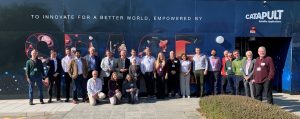
In April 2025, the Satellite Applications Catapult (SAC) convened 26 stakeholders from 17 organisations to explore what it would take for the UK to lead in microgravity-enabled healthcare. The workshop, delivered in partnership with Cranfield University, Medicines Discovery Catapult and Weston Strategy Labs, was not designed as a showcase of futuristic concepts, but as a working session focused on understanding barriers to adoption and identifying practical steps forward.
At the time, there was clear interest in the scientific potential of microgravity for drug discovery, formulation studies, organoid development and regenerative medicine. There was also a growing recognition that the economic opportunity could be significant, with non-space economic benefits estimated at over $3bn in contract research alone by 2035, according to a McKinsey 2022 study[1]. However, the workshop made one thing very clear: the challenge was not scientific credibility, but translation. The UK did not lack expertise in life sciences or payload design; what it lacked was a structured mechanism to integrate the two.
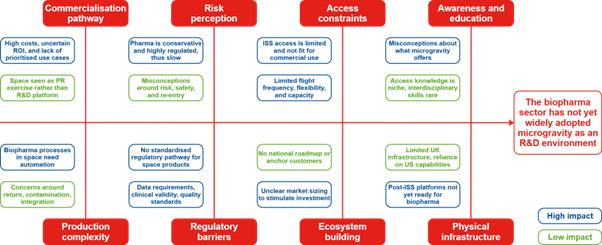
Barriers identified during the workshop that limit adoption of microgravity by biopharma companies
Recognising the need for greater collaboration between industry, government and academic stakeholders around microgravity R&D in life sciences, we established the Microgravity Life Sciences (MLS) Working Group, which has met every quarter since the workshop and brings together over 20 organisations across the triple helix. The Working Group is coordinated by the UK-Beyond Earth Network (UK-BEN), one of SAC’s Connected Capability Networks (CCNs) to maximise the reach of the network and draw on the wider expertise available. The five priority areas that emerged over the course of the workshop were translated into five workstreams within the working group: supporting the development of a strong business case for space-based R&D, facilitating knowledge exchange between the life sciences and space sectors, building a cohesive cross-sectoral ecosystem, supporting the evolution of regulatory and policy frameworks, and improving the accessibility of space infrastructure for life science microgravity R&D.
One of the strongest messages from industry participants was that microgravity would only move beyond isolated experiments if it could be translated into a compelling commercial proposition. Pharmaceutical and biotech companies are driven by pipeline acceleration, IP differentiation, and de-risking of development pathways; enthusiasm alone does not unlock budget.
Over the past year, we have therefore focused on developing an evidence-based framework that translates specific microgravity R&D use cases into structured business cases with clearly articulated ROI. This includes working with the Industrial Biotechnology Innovation Catalyst (IBIC), delivered by the University of Manchester across the North West, to validate and prioritise high-impact use cases by running a matchmaking session to convene academics with space biotech expertise, biotech SMEs, and space biotech innovators and payload specialists, and fund at least two SME-led pilot projects.
This session will be hosted at the Manchester Institute of Biotechnology on 29 April. During this hands-on, hackathon-style workshop, academics, biotech SMEs from the North West, and payload specialists will form and develop new R&D projects for microgravity experimentation. Participants will work in teams to shape project concepts and pitch them for IBIC proof-of-concept funding, with additional technical and commercial support from SAC. If you’re interested in learning more about our collaboration with IBIC and how to get involved, please sign up for the event here, and join our upcoming webinar on 9 April for more information.
In parallel, we are supporting UK payload specialists such as BioOrbit, Frontier Space and Kayser Space to strengthen their commercial positioning and integrate more closely with life sciences workflows. The intention is not simply to stimulate activity, but to create repeatable and scalable models that demonstrate how microgravity-enabled R&D can sit within mainstream drug development strategies.
Positioning Microgravity as a Research Environment
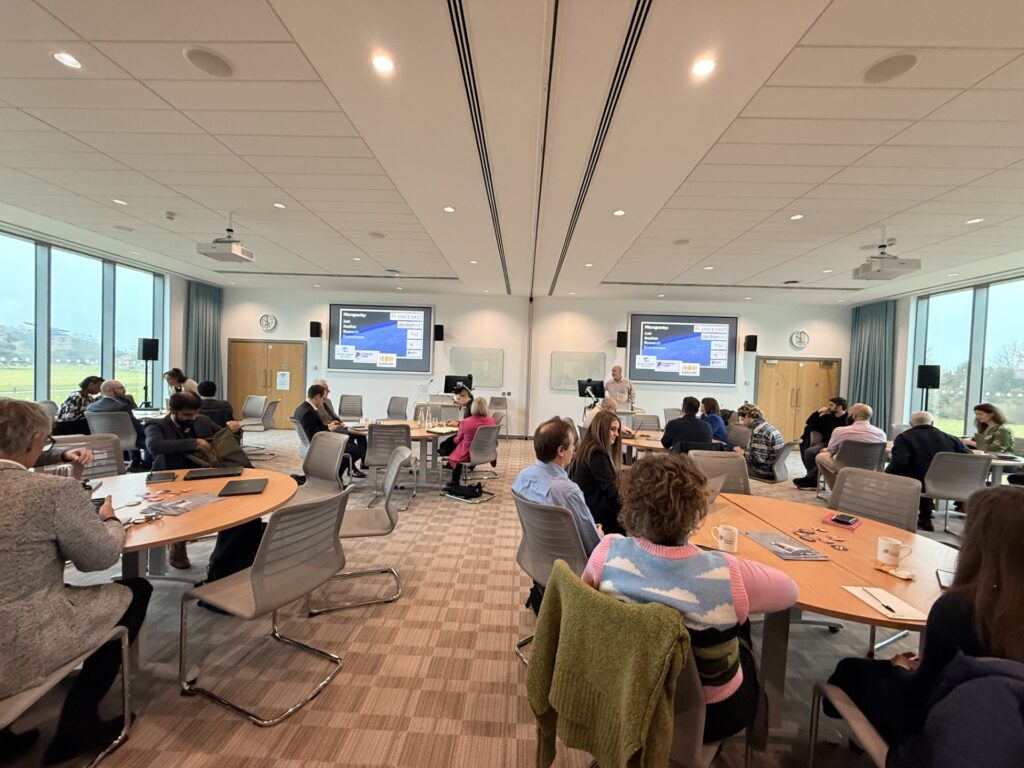
A second priority has been reframing the conversation. Too often, microgravity is perceived as exotic or disconnected from routine R&D practice. Through the UK-Beyond Earth Network, in January 2026, alongside Latitude Launch Vehicles and Space Cargo Unlimited we co-sponsored and participated in an event designed by Plastron UK and Space East, and hosted by the Babraham Research Campus titled “Microgravity: Just Another Research Environment”, which brought together around 50 researchers and industry participants to explore practical applications in areas including cancer research, ageing, agri-tech and equipment standardisation.
The objective was to normalise microgravity as an additional research tool rather than a novelty. As part of the working group, other proposed ideas include developing a Microgravity Readiness Toolkit, a repository of case studies, and a follow-on workshop for biopharma organisations that have already conducted experiments in space but have not yet progressed further. These activities are designed to lower the barriers to entry and ensure that initial engagement does not stall at proof-of-concept stage.
Strengthening the Ecosystem
Since our original workshop in April 2025, we have continued to engage across conferences, cluster networks and sector-specific forums to ensure that the conversation remains connected and coordinated. This includes engagement with early adopters, targeted design workshops, and structured use case mapping with academic groups.
The Beyond Earth Mission’s wider goal is to establish the UK as an integral supply chain actor and service provider within the global ISAM market by 2035. For biopharma, that ambition requires alignment across space infrastructure providers, biotech SMEs, large pharmaceutical companies, regulators, and health system stakeholders. The past year has been focused on building those connections deliberately rather than relying on ad hoc collaboration.
Engaging Regulators Early
Given that both space and life sciences are highly regulated sectors, regulatory clarity is fundamental to adoption. Over the past twelve months, we have engaged with regulatory and enabling bodies through the UK Space Agency funded Unlocking Space for Government programme to better understand evidence requirements and to inform the development of guidance and whitepapers that support the pathway to adoption.
This includes understanding the requirements of the NHS value chain for microgravity-enabled R&D, and aligning conversations with broader national priorities such as the Life Sciences Sector Plan and reforms aimed at accelerating access to innovative treatments. The aim is to ensure that microgravity-enabled research does not remain peripheral, but is positioned within established regulatory and clinical frameworks.
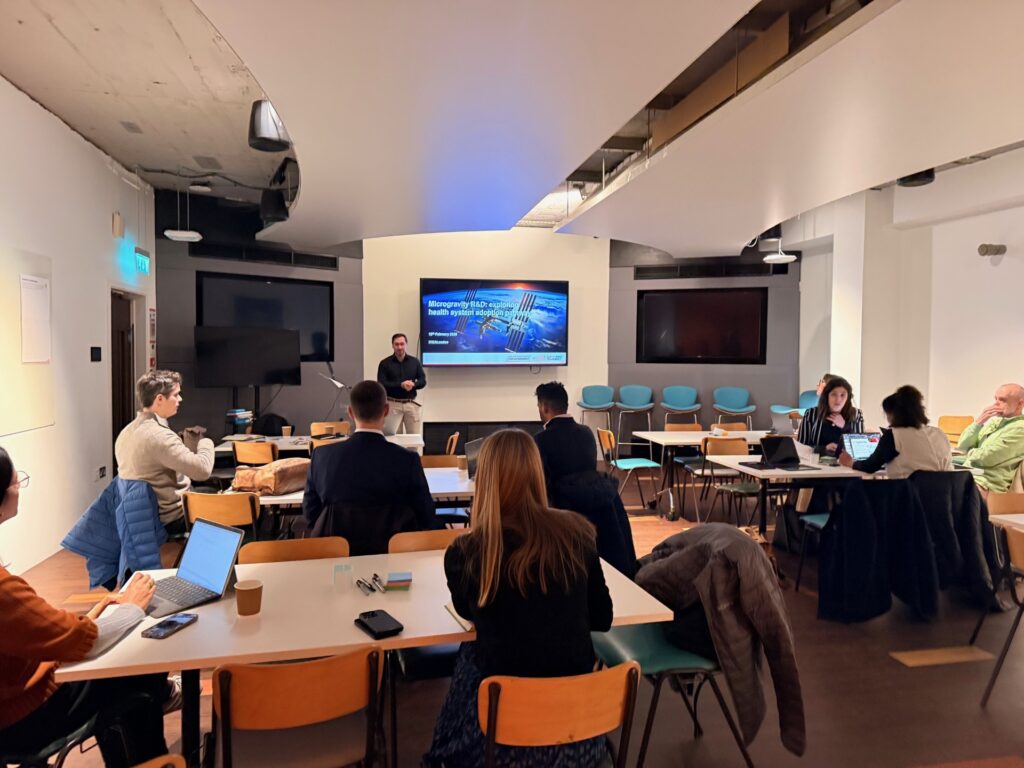
In this context, we convened a workshop in February bringing together health system stakeholders, healthcare regulators and payload specialists and biotech innovators to explore and understand regulatory, appraisal, and adoption pathways – including BioOrbit, Kayser Space, Frontier Space Technologies, Mass Balance, and Space Pharma. Insights from this event have now directly contributed to a joint government statement from MHRA, the UK Space Agency, the Civil Aviation Authority and the Regulatory Innovation Office confirming that they are working collaboratively to provide a supportive regulatory environment to space, biopharma and pharmaceutical companies.
Making Infrastructure Accessible
Finally, we have begun addressing practical infrastructure questions. For life sciences stakeholders, access to in-orbit platforms, payload systems and experiment integration processes can appear opaque. We are therefore defining user requirements, developing guidance for accessing available capabilities in the form of a Microgravity Service Providers Marketplace, and scoping the feasibility of a dedicated Microgravity Research Centre that could bridge life sciences and space infrastructure.
Without operational clarity, commercial ambition is unlikely to translate into sustained activity. Infrastructure alignment is therefore as important as scientific validation.
From Interest to Implementation
One year on, the most meaningful change is not a single breakthrough experiment, but a shift in posture. Microgravity-enabled drug discovery in the UK is moving from isolated scientific curiosity towards structured implementation.
We now have: a defined collaborative roadmap, an active working group operating across five delivery pillars, funded pilots in development, ongoing regulatory engagement, and a growing and more coordinated ecosystem.
There is still work to do, particularly in generating robust commercial proof points and scaling early successes. However, the conversation has matured. The focus has shifted from whether microgravity is interesting, to how it can be integrated responsibly and commercially into UK life sciences.
For the Beyond Earth Mission, that represents tangible progress. The foundations are being laid for the UK not only to participate in, but to shape, the emerging microgravity-enabled healthcare market.
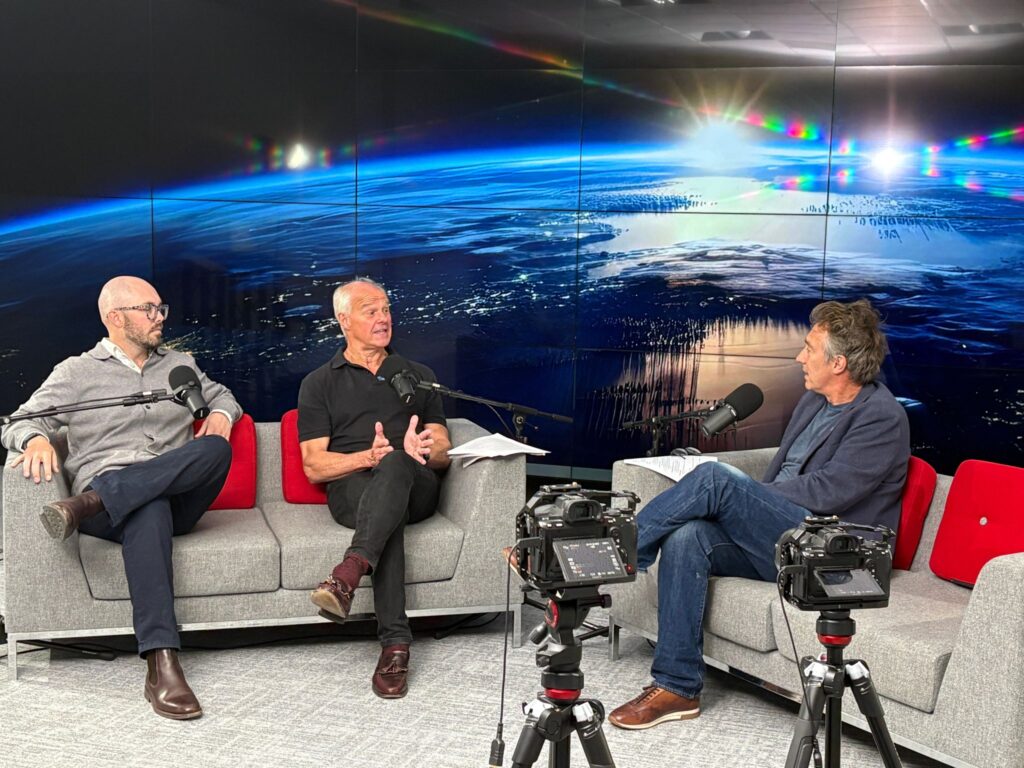
You can also listen to our podcast episode “Microgravity: Developing Drugs in Space”, where Martin Braddock from GenixiConsulting Ltd, William Birch from SAC, and our host Dallas Campbell discussed the applications and benefits of microgravity.
We help organisations make use of, and benefit from, satellite technologies, and bring together multi-disciplinary teams to generate ideas and solutions in an open innovation environment.
Related articles
Unlocking the Potential of Microgravity: A New Frontier for the Biopharmaceutical Industry
The Satellite Applications Catapult is proud to announce the inaugural meeting of the Microgravity Life Sciences Working Group. The group was brought together following a...
To provide the best experiences, we use technologies like cookies to store and/or access device information. Consenting to these technologies will allow us to process data such as browsing behavior or unique IDs on this site. Not consenting or withdrawing consent, may adversely affect certain features and functions.
Functional
Always active
The technical storage or access is strictly necessary for the legitimate purpose of enabling the use of a specific service explicitly requested by the subscriber or user, or for the sole purpose of carrying out the transmission of a communication over an electronic communications network.
Preferences
The technical storage or access is necessary for the legitimate purpose of storing preferences that are not requested by the subscriber or user.
Statistics
The technical storage or access that is used exclusively for statistical purposes.The technical storage or access that is used exclusively for anonymous statistical purposes. Without a subpoena, voluntary compliance on the part of your Internet Service Provider, or additional records from a third party, information stored or retrieved for this purpose alone cannot usually be used to identify you.
Marketing
The technical storage or access is required to create user profiles to send advertising, or to track the user on a website or across several websites for similar marketing purposes.