From Insight to Implementation: A Year of Progress in Microgravity R&D
In April 2025, the Satellite Applications Catapult (SAC) convened 26 stakeholders from 17 organisations to explore what it would take for the UK to lead...
Two UK research teams have won proof-of-concept funding to test whether microgravity can speed up skin-ageing research and make metal recovery more sustainable. The awards come through the IBIC x Catapult Microgravity Biopharma Accelerator, the first UK programme to treat orbit as a practical research environment for the life sciences. The Satellite Applications Catapult and the Industrial Biotechnology Innovation Catalyst (IBIC) run the programme together, bringing biotechnology businesses, academics and space sector specialists into the same teams.
The two projects are SPACE AGE, led by the University of Liverpool in partnership with biotech company GMP Manufacturing Ltd and microgravity specialist Space Cargo Unlimited; and Co-Crystals: Microgravity Enhanced Crystallisation of Metalloproteins for Bio-mining, led by the University of Salford in partnership with biotech company LanthaGen Bio and microgravity specialist Kayser Space. Each has received an IBIC proof-of-concept award of around £50,000 and will receive tailored, in-kind technical and commercial support from the Satellite Applications Catapult.
SPACE AGE draws on evidence that microgravity triggers changes in human cells resembling ageing, but over weeks rather than decades. If those changes hold for skin, researchers could test treatments in a fraction of the usual time.
Co-Crystals studies metalloproteins, which bind metals and could be used to recover them from ores and waste with less energy and fewer harsh chemicals than conventional extraction. Crystals grown in microgravity are often larger and better ordered, giving researchers a clearer view of how these proteins capture metals and how to design better ones.
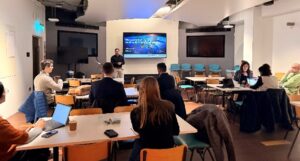
The projects began at a one-day matchmaking workshop in Manchester in April 2026, which launched the accelerator. Academics from north-west England, biotechnology businesses and UK microgravity specialists formed teams around credible research and commercial challenges. The winning teams then went through IBIC’s proof-of-concept funding process.
The accelerator aims to close the gap between early scientific interest in microgravity and projects that are technically credible, commercially relevant and ready for investment. IBIC provides the funding and manages the awards. The Satellite Applications Catapult designs the accelerator programme, assesses each project and supports teams on technical feasibility, commercialisation, partnerships and investment readiness.
The programme treats microgravity as a research tool, not a destination. It aims to help life sciences organisations find where a change in gravity gives a measurable scientific or commercial advantage, and to build a repeatable model for linking the UK’s regional biotechnology strengths with its space sector.
Nasreen Dhanji, Beyond Earth Mission Lead at the Satellite Applications Catapult, said: “The strongest microgravity projects start with a clear challenge on Earth. This accelerator has brought together the scientific, commercial and space expertise needed to turn promising ideas into practical proof-of-concept projects. SPACE AGE and Co-Crystals show the breadth of the opportunity, from health and treatment development to more sustainable approaches for biomining.”
Professor Aline Miller, Director of the Industrial Biotechnology Innovation Catalyst (IBIC), said: “North-west England has deep strengths in industrial biotechnology, and part of IBIC’s job is to help those researchers and businesses reach new markets. Microgravity gives our community a research setting that few have been able to use, and proof-of-concept funding lets teams find out quickly whether it gives them a real advantage. SPACE AGE and Co-Crystals show what can happen when biotechnology and space specialists work on the same problem from the start.”
Representatives from the funded projects and programme partners will join a panel hosted by the Satellite Applications Catapult at ELRIG Drug Discovery 2026 on Wednesday 14 October at ExCeL London.
The session, Beyond the lab: Expanding biopharma R&D into new environments, will introduce the funded projects and examine how research settings beyond the laboratory, including microgravity, can help biotechnology answer questions it cannot answer on the ground. Panellists will discuss the science behind their work, the partnerships the accelerator formed and the path from proof of concept to demonstration and commercial use.
The accelerator forms part of the Catapult’s Beyond Earth mission, which works to make microgravity research commercially accessible to UK businesses. Results from the two projects will inform future demonstrations, investment decisions and, where the evidence supports it, experiments in orbit.

In April 2025, the Satellite Applications Catapult (SAC) convened 26 stakeholders from 17 organisations to explore what it would take for the UK to lead...

A marketplace that helps organisations find the providers, facilities and funding they need for microgravity research. In microgravity, researchers can study biological systems, materials and...