The LOFT Project

LOFT (Loose Fit Clamp Technique for Assembly of Large Space Structures) is an ESA-funded project led by the Satellite Applications Catapult, in collaboration with Foster + Partners, Technische Universität München (TUM), TU Wien, and space architecture expert David Nixon.

Funded by

ESA logo with stylized text and the words "European Space Agency" below.
Close-up of a cutaway model of a jet engine showing metal turbine blades and internal components.

consortium

The Challenge

As technology advances, future space missions become more complex and therefore require larger structures than can be sent from Earth in a single piece. The LOFT Project is exploring how we can utilise robotics for in-orbit assembly of modular structures, enabling these structures to be built in space.

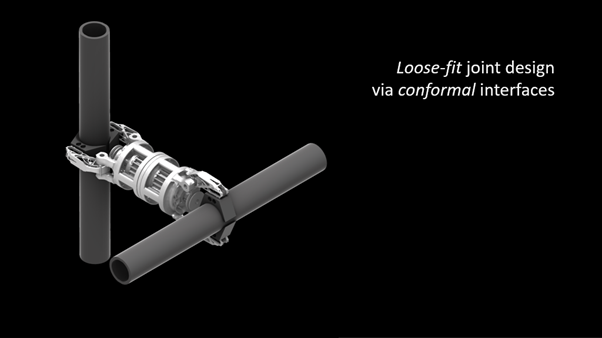
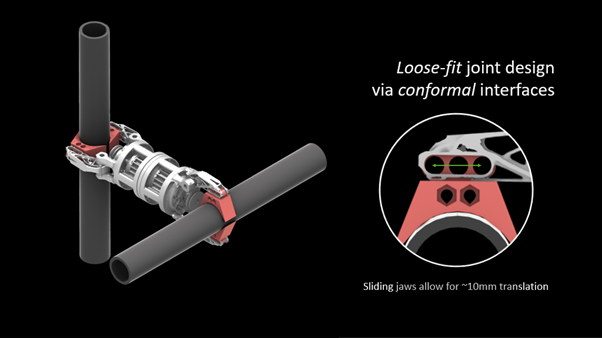
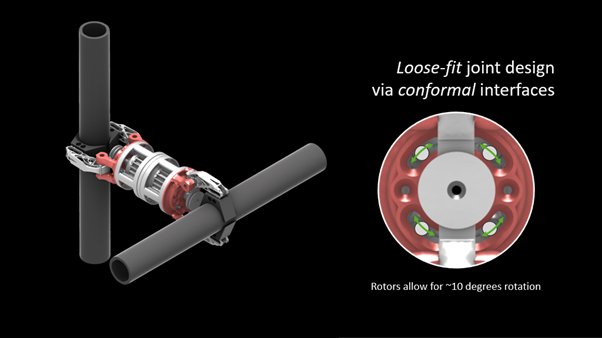
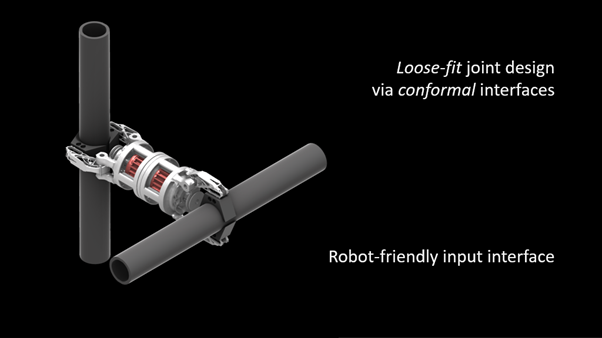
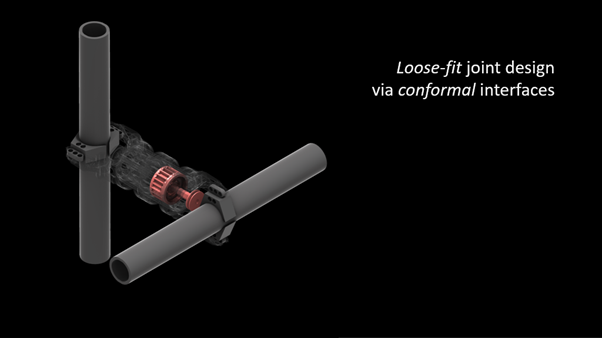
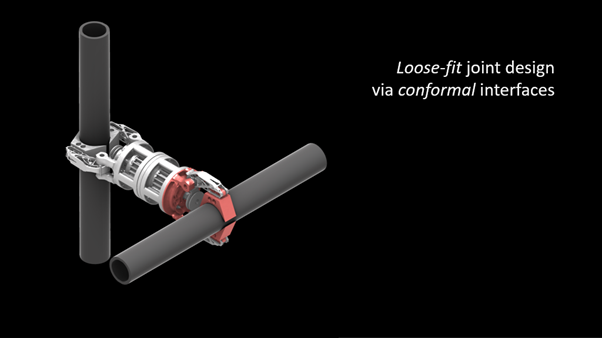
Working together with the consortium, the challenge is to design and produce different parts that, through a loose fit strategy, can tolerate positional and rotational inaccuracies, thereby enhancing fault tolerance and scalability in autonomous assembly.

The Solution

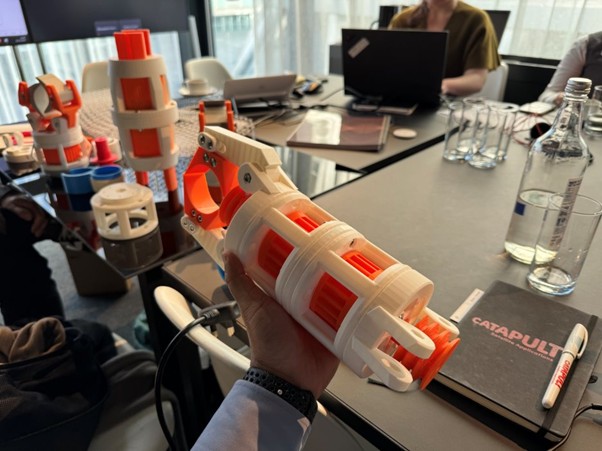
A hand holds a 3D-printed device at a table with laptops, notebooks, bottles, and more 3D models.

The project aims to develop a novel modular assembly system for large space structures using self-closing, self-locking joints that enable robotic construction with high geometric flexibility. The system is designed to be scalable, reconfigurable, and tolerant to misalignment, making it ideal for future space habitats, solar power platforms, and scientific infrastructure. Through a series of design, simulation, fabrication, and testing phases, LOFT will advance the technology from TRL 2 to TRL 4, culminating in a laboratory-based demonstration of feasibility and performance. 

Progression

Current Phase

The project has progressed into detailed design and modelling activities to validate the fundamental principles of the LOFT approach.

Key activities include:

  • Development of detailed CAD models of the clamp and interface system
  • Structural and mechanical analysis of assembly interfaces
  • Finite Element Analysis (FEA) to assess load transfer, stiffness, and structural performance
  • Assessment of manufacturing methods and material selection
  • Refinement of the design based on analytical results

Outcome: Critical functions of the LOFT mechanism have been demonstrated through engineering analysis and simulation, providing confidence that the concept can meet future operational requirements.

Planned (August)

The next major milestone is the validation of the LOFT system in a representative laboratory environment using physical hardware.

Planned activities include:

  • Manufacture of prototype LOFT clamp assemblies
  • Physical assembly and integration testing
  • Verification of structural performance against analytical predictions
  • Assessment of assembly repeatability and interface robustness
  • Evaluation of operational procedures for robotic and human-assisted assembly scenarios
  • Collection of test data to validate design assumptions and simulation models

Expected Outcome: Demonstration that the LOFT assembly approach functions reliably in a representative environment, successfully achieving TRL 4 and establishing a foundation for future robotic in-orbit assembly demonstrations.

Find out more:

Contact us to find out more about the project and how you can collaborate with us.

More case studies

Empty road leading to horizon under a sky filled with fluffy clouds.

Business Incubation at Westcott: Valerann

Route to Impact There is significant global competition to deliver the future mobility systems that will revolutionise the movement of…

Space Applications Autonomous & Connected Earth Westcott Space Cluster
February 13, 2020
Digital globe with glowing lines and dots, representing global social networks and connectivity.

The Space Commercialisation Engine: Facilitating the use of EO Data

Context The Space Commercialisation Engine (SCE) was designed to leverage Earth Observation (EO) data for business innovation. It aims to…

Resilient Earth
March 13, 2026